
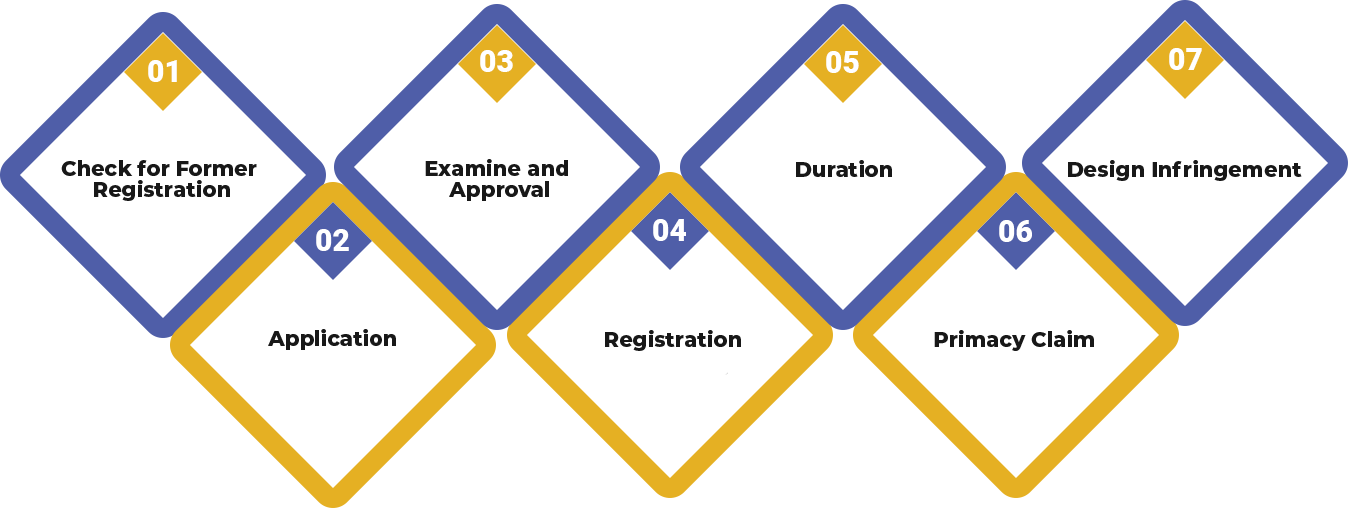
Soon after submitting application for design registration in orderly format, it is accepted and the design is registered. Thereafter, a certificate of the design registration shall be issued to the applicant. However, a different request should be made by the applicant to the Controller of Designs for obtaining of a certified copy of that certificate for the purpose of legal proceeding, along with mandatory government fee.
Design Registration
Grow Start Initiate Your Business With Us
Design Registration gives an exclusive right to its actual owner. This registration provides authority to the owner to use the Design for ten years, and the time can be further extended for the next five years.
Start Your Company Without Any Hassel
Cognizant Advisors is an online business compliance platform that helps entrepreneurs and other individualities with several, enrollments , Tax fillings, and other legal matters.

Get Quote Instantly in a Minute
Menu
Introduction
Design Registration
A design is defined under Section 2(d) of the Designs Act 2001, as only the features of a shape, pattern, configuration, composition, or ornament of lines or colors that are applied to any article that is two dimensional, three dimensional, or both by an industrial process or any means whether mechanical, manual or chemical, separated or combined, which in the finished article are judged solely by the eye; but is not taken into account upon the principle of construction or anything which is in substance a merely mechanical device.
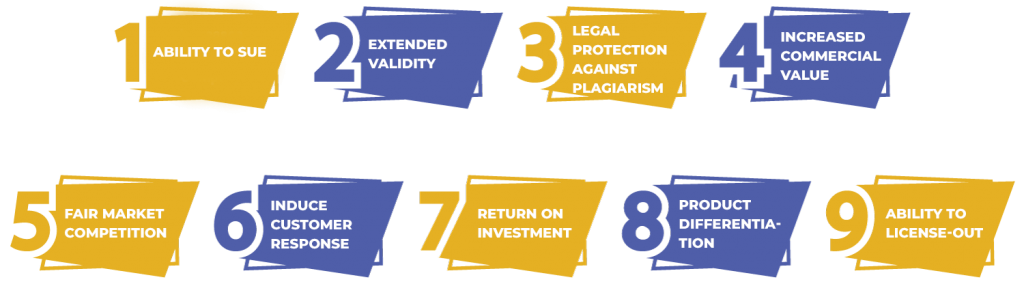
Advantages of Design Registration in India
- Exclusive rights over the new and original design
- An asset of the proprietor/owner
- Can initiate a legal proceeding in case of infringement by a third-party
- Serve as a prima facie evidence in an infringement suit
- Right to sell, transfer and license the design with ease

Benefits
Benefits of Design Registration
Process
Design Registration In Easy Steps
Document Checklist
Documents required to Design Registration
Design Questionnaire
Classification and description of work
Power of Attorney for Design filing (Form-21)
Colour Photographs from Aarious Angle
Faq
Frequently Asked Questions (FAQ)
As per the Designs Act 2000 the term "article" refers to any article of manufacture and any substance, whether artificial, or partially artificial and partially original. This also includes all components of that article capable of being finished and sold separate to each other.
The main intent behind obtaining the Design registration under the Designs Act is to safeguard new or innovative designs that created for application on a particular article, which is to be manufactured by an Industrial Process or mode, from being copied. Sometimes the buying of articles for consumption is affected not only by their practical quality but by their outer look too. The significant purpose behind design Registration is to make sure that the artisan, inventor designer of a design having artistic look is not dispossessed of his bona fide prize by any other who are imitating his design to their own goods.
As per the Designs Act 2000 the term ‘Design’ refers only the characteristics of shape, configuration, patterns or adornments or the work of art including lines or hues or a blend thereof applied to any article. A design can be either 2 dimensional or 3 dimensional or in both types, by any industrial process or means, whether labor-intensive, automatic or chemical-based, separate or joint, which in the completed article attract and are recognized solely by the naked eye, but does not consist of any method or principle or manufacturing or anything which is in substance a simple mechanical device. This does not take account of any trade mark, as defined in section 2(v) of the Trade and Merchandise Marks Act 1958, a property mark or a creative work as defined under Section 2(c) of the Copyright Act 1957.
The Register of Designs is a basically a document maintained by The Patent Office, Kolkata. It is a legal requirement. This register encloses the design number, its class number, date of filing (in India) and reciprocity date (if any), name and address of the Proprietor and other relevant matters that would influence the validity of proprietorship of the design and it is open for public assessment on the imbursement of the prescribed authoritative fee & excerpt from the designs register shall also be obtained on the request along with the prescribed government fee.
No, the above mentioned objects are not eligible for Design registration. The reason is that once the supposed Design i.e., adornment is erased only a piece of paper, metal or like material remains and the particularly the article referred will not exist. Article must have its own presence free of the Designs applied on it. [Design in respect of the label was held not eligible for Design registration, by an Order on civil original case No. 9-D of 1963, Punjab, High Court]. Hence, the Design as applied to an article should be considered integral with the article itself.
The date of registration except in case of priority document shall be the actual date of filing the design application. In case of the design registration of the priority document, the date of design registration shall be the date of making the application in the reciprocal nation.
No, even if the design is registered, but it’s the copyright has expired, cannot be re-registered under Designs Act 2000.
The registration of a proposed design confers upon the registered proprietor’s ‘Copyright’ in respect of the design for the period of his registration. Here ‘Copyright’ means the special right to apply a design to his article falling under the class in which it has been registered.
Piracy of a design refers to the application of a design or its cheap imitation to any article belonging to the same class of the articles where the proposed design was registered, for the purpose of the sale or importation of such articles without the written consent of the registered proprietor. Publishing such articles or revealing the terms for the sale with information of the illicit application of the design to them also comes under the definition of design piracy.
Customer Reviews
Our clients love and vouch for our services
★★★★★ 5/5


